Poverty: The Human Equivalent of Climate Change?

Cranhill-009

The attached article caught my eye, especially the sections set out below, for the reasons stated afterwards:

Doctor Sir Harry Burns was the Scottish government’s chief medical officer for nine years until 2014 and he has made the study of health inequalities in society the defining characteristic of his lifetime of work. He wants governments to underpin their approach to meeting the challenge of deprivation with science. “The seeds of deprivation are sown very early in life. Chaos and uncertainty and poor parenting produce a range of biochemical processes that lead to a reduced ability to learn, to engage socially, and to an increased exposure to acquiring chronic disease in later life. We’re seeing this in some parts of Glasgow,” he says.

“Studies have shown that the brains of young animals which are neglected or exposed to threat develop differently. The parts of the brain connected to learning and empathy don’t develop properly. In the field of genetics it’s been shown that the lower down the social scale you are, the faster your DNA ages. All around the world where people have looked at this there is a consistent story. Difficult circumstances in early life lead to bad outcomes, and not just in health.

“There is nothing special about Glasgow. We’ve just had a bigger dose of this. When people lose their traditional ways of living, when they are disconnected from their traditional structures, they take drugs and start fighting. When you talk to young men of 17 and 18 in places like Polmont Young Offenders Institution, they consider their lives finished.”

It is a part of my narrative that we correct social dysfunction by finding solution to the immediate problem, without emotive reference to and the granting of exceptions due to historical disadvantage and prejudice.

For example, I believe the answer to the bad relationship in some parts of the US between police and the communities they serve is best addressed by notions such as citizen design of policing. And, if we improve the behavior of police towards all, then no special exemptions need to be entertained with respect to a community which talks of 400 years of oppression, risk and prejudice.

But, what if I’m wrong? What if disadvantage causes not merely an immediate emotional dysfunction, but a long-term medical one? Is it the case that exceptions should be made? Or, that I am still right (so that we do not create new inequalities)? But that any addressing of social justice inequality counts for nothing if not accompanied by dramatic improvement in economic circumstance and opportunity? Can I truly divorce the two?

Creative Engagement – The Redux

SWAT_engagement_photos_35b89

I just added another couple of responses to a post on OrangePolitics, talking about getting feedback from people within their comfort zone, not ours. I have written about this before, also on OrangePolitics.

I believe creative citizen engagement to be crucial with respect to creating a process that fully engages communities with the notion of citizen design of policing. But it has wider implications, too. The latest OrangePolitics post and comments are worth reading in their entirety.

Carrboro, Citizens, Policing – Conflation and Progress

Occupation5_web

I link to my latest update on the evolving process ultimately to allow the citizens of Carrboro, NC to design the policing approach in our community, a process I believe is essential to improving the relationship between all citizens and our police (in Carrboro and around the US), and a process which can more easily be explored in a community like Carrboro, which has a reputation for innovative approaches to governance.

This comment, the discussion thread in which it is embedded, and the links contained, offer an excellent reference point for learning about, becoming involved in and influencing the drive for citizen design of policing in Carrboro, along with my own blog – https://citizenpolicing.com/.

Now, nothing is going to happen unless citizens of Carrboro make the time to attend the community forums being staged by the Carrboro police and the Carrboro Board of Aldermen. Those forums are the focal point for evolving citizen design of policing. All the wishful thinking, chit-chat here on FB and elsewhere, marches and the like, will count for nothing unless we attend those forums, and evolve them into a sustainable ongoing process of citizen policy making for Carrboro police.

So. It is now up to us to make this happen.

Citizen Policing: More on Balanced Approach

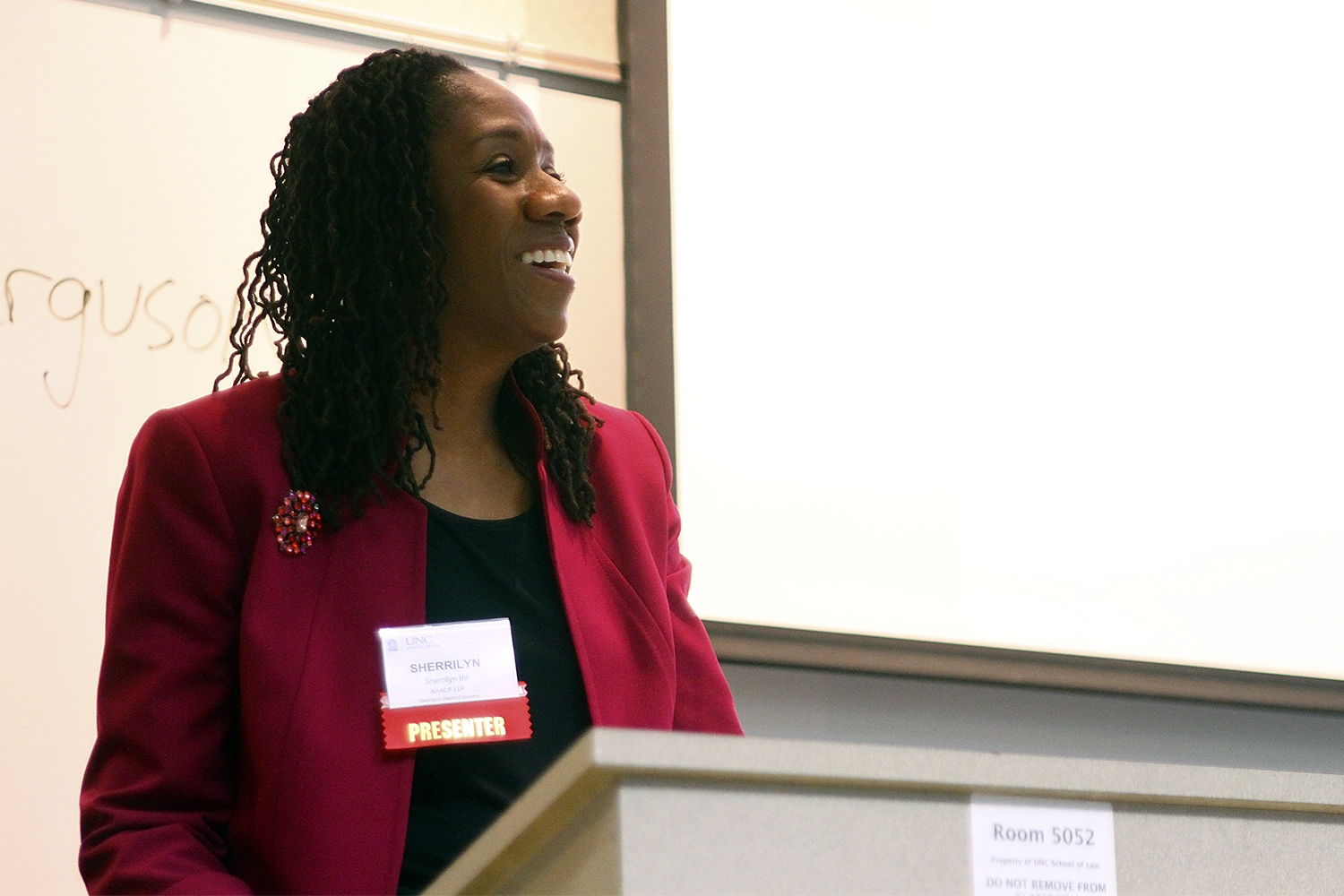
Ifill was the keynote speaker on Friday at the UNC School of Law in Chapel Hill, NC (where I live) as part of an all-day event titled “Police Violence in the Wake of Ferguson and Staten Island.” The conference brought together people from a variety of backgrounds, including police officers, lawyers, professors and students.

This excerpt from the local newspaper coverage caught my attention:

‘Michael Troutman, assistant public defender in Guilford County, said he attended the event because he often confronts these issues in his work.

Troutman said Ifill’s strategy to increase implicit bias training among police officers has merit, though he thinks the training should go both ways.

“Her solution of expanding training among law enforcement is one strategy, but on the other side, it is educating people how to deal with those encounters as well,” he said.’

As I continue gently to advance the notion of citizen design of policing [https://citizenpolicing.com/], I find myself coming up against an insistent subliminal rhythm of a narrative which bothers me. It is a narrative which says that there are some who need to be treated more than equally.

Why?

The ambition of the notion of citizen design of policing is that, in the relationship between law enforcer and citizen, there should be an equality of respect and treatment for and with all manner of participants, an equality designed and monitored by a body representing the majority view of the community being policed.

That equality is undermined the moment any one of the potential participants demands ‘extra’ equality.

I find this subliminal narrative especially disturbing when it comes from someone in a position of authority and stature. So it is that Sherrilyn Ifill says this:

‘One solution could involve having conversations about the lasting harms of white people not spending time around black people, she said.

“I think we can no longer afford to live as two separate countries,” she said.’

Precisely.

I hear, and therefore accept (I can not know; I am not black), that there are blacks who say they feel like they live in a separate country. Our ambition should be that all feel we live one country. Agreed.

You do not achieve that by introducing a new inequality. By saying, there is a group which requires special accommodation by the police.

I live in a low-income housing project. I do not expect to behave any differently to the folks living alongside me. I do not expect any different treatment or accommodation.

I am a minority of one. There is plenty that the majority in my complex, my neighborhood, my town, my state, my country determine should be the way of something that I do not like. I do not have the right as a minority to demand special hearing or accommodation.

If we are one country, then we must be one country.

There is also the hint of a suggestion that black people are different, and that white police officers should spend special time around them, so as better to understand them.

I’m sorry. At the risk of losing whole swathes of FB Friends, this borders on anthropological clap-trap. And it is, in my opinion, incredibly patronizing about my many black friends.

I repeat, in so far as citizen design of policing is concerned, we address all of Sherrilyn’s concerns by having a policing approach designed by citizenry which treats all citizens with equal respect.

We are not all born equal. Never were. Never will be. What we can all work for is a situation where all may have equal opportunity and equal treatment under and by the law. Nothing more. Nothing less. No special favors for anyone.

Carrboro, NC – CHASER

Horton-e1412694127271-513x350

Andddddddd. Yup. It’s time for a wee bit of insistent pressure. So. I sent a chaser to the Carrboro Board of Aldermen, along with Chief Walter Horton of the Carrboro Police. And yes, I tag everyone, because it’s called ‘citizen lobbying’:

“Hey Everyone,

I held off following up further on the conversations we’ve been having about the above, in view of the focus on the Arts Center proposal. I wasn’t able to attend the meeting last evening. And haven’t watched the stream. But I have read the limited coverage in Chapelboro.

As with the various policing forums, the meeting was well attended. What was interesting was the manner in which the matter is being taken forward. Driven by the Board. Involving at least one more meeting. With the Board looking ot encourage certain attendees. And the possibility of a work session. I see possible similarities as to how one could move forward the discussion on involving citizenry more in the design and monitoring of our policing.

Damon, I know there are certain things you are looking into, but I was kind of hoping for your notes on what we had been discussing. What are the next immediate plans? Is it intended there be any more movement before the forum currently planned for June? I would hope so.

All the best,
Geoff”

Sir Robert Peel’s Nine Principles of Policing

peel

One of the parties with whom I am engaging on the notion of citizen design of policing (I will leave it to them to identify themselves if they wish; I tend to be more courteous with my advocacy, in direct proportion to the extent of the courtesy with which I am likewise engaged!). Anyway, one of the parties directed me to the Nine Peelian Principles of Policing. I have much to catch up on!

They are:

PRINCIPLE 1 “The basic mission for which the police exist is to prevent crime and disorder.”

PRINCIPLE 2 “The ability of the police to perform their duties is dependent upon public approval of police actions.”

PRINCIPLE 3 “Police must secure the willing cooperation of the public in voluntary observance of the law to be able to secure and maintain the respect of the public.”

PRINCIPLE 4 “The degree of cooperation of the public that can be secured diminishes proportionately to the necessity of the use of physical force.”

PRINCIPLE 5 “Police seek and preserve public favor not by catering to the public opinion but by constantly demonstrating absolute impartial service to the law.”

PRINCIPLE 6 “Police use physical force to the extent necessary to secure observance of the law or to restore order only when the exercise of persuasion, advice and warning is found to be insufficient.”

PRINCIPLE 7 “Police, at all times, should maintain a relationship with the public that gives reality to the historic tradition that the police are the public and the public are the police; the police being only members of the public who are paid to give full-time attention to duties which are incumbent on every citizen in the interests of community welfare and existence.”

PRINCIPLE 8 “Police should always direct their action strictly towards their functions and never appear to usurp the powers of the judiciary.”

PRINCIPLE 9 “The test of police efficiency is the absence of crime and disorder, not the visible evidence of police action in dealing with it.”

I don’t necessarily disagree with them. But I would add a 10th:

PRINCIPLE 10 “The measure of policing success is the degree to which a community is demonstrably at peace, both with itself and with its police force; not the extent to which either seeks to demonstrate a false peace.”

Or some such. There is still about Peelian Principles a whiff of the police being an authority unto themselves. I note Principle 7. But the mere enunciation of the fact that a police officer is a citizen is not the same as saying citizens have to be comfortable with their policing.

To be honest, I’m not totally sold on the notion of citizen design of policing. I am painfully aware of the full import of Principle 5. In line with earlier comments today, I know how easy it is for a small but vociferous group of individuals to overwhelm any democratic process. Which could class as ‘catering to public opinion.’

I am merely of the view at the moment that we need demonstrable satisfaction of the people with their policing. Which perhaps needs a little less ‘co-operation of’ and a tad more immediate ‘design by.’

Creative Citizen Engagement

Flower_Power_by_Bernie_Boston

I just added a response to a post on OrangePolitics, talking about getting feedback from people within their comfort zone, not ours. I believe this to be crucial with respect to creating a process that fully engages communities with the notion of citizen design of policing – https://citizenpolicing.com/. But it has wider implications, too. The post and comments are worth reading in their entirety. My response:

“I would be a millionaire if I had a penny for every time I have told the ‘powers-that-be’ that sensible community engagement requires engaging with people in their comfort zone, not in the comfort zone of those wanting answers.

Whether it was advocating for youth facilities at the age of sixteen in my home town in England, meeting with constituents as a municipal councilor at the age of 23, attempting to increase democracy within Weaver Street Market Co-operative, or inviting views on the issue concerning me at the moment (citizen design of policing – https://citizenpolicing.com/), time and again I have tried to convince folks that it is incumbent on them to go to the people, not the other way around.

It really is not beyond the ken of creative elected and unelected public officials to find ways to engage with people who are not comfortable in crowds, in public, at times that are inconvenient to them, on camera, and the like. You raise the perfectly good example of asking folks to engage with their social circles, and then report back. It’s not good enough for those same officials to say, well it’s not convenient for me; ooh, I wouldn’t want to go there; I’d rather stay behind my table, thank you.

Couple of caveats. If officials do find creative ways to engage, visiting bars, holding mini-meets in apartment complex offices, whatever, then folks, we have to find the time to respond and engage right back. You can’t find the NFL more interesting, and then complain a month later you weren’t asked.

Taking Weaver Street Market as an example, I stood for the Board of Directors four times as a Worker-Owner Candidate. I very quickly learned that fellow worker-owners had become very disillusioned over the years, and simply did not feel it was worth voting anymore. I undertook a long-term effort to try to re-engage fellow worker-owners.

I regularly visited units when workers were off-the-clock. I started a blog. I made my campaign to become a Worker-Owner Director a rolling, multi-year affair, more concerned with engagement than getting elected. I assiduously communicated with every new employee, to invite them to be Friended on Facebook. As a consequence of which I have about 60% of the workforce of WSM Friended on Facebook. A workforce of about 250 which, several years ago, had 100 worker-owners, and now has 192.

Even so, it pretty much remained the case that my fellow workers didn’t want to take the time (their time, by the way; always off-the-clock, by-the-way, WSM management please take note!) to engage in ‘official’ exercises of feedback or to attend meetings. So, I would attend. And mention that fellow workers had passed their views onto me (which they had, and which they still do, regularly). Views which I tried faithfully to represent, even though I didn’t always agree with them.

And there was the rub. Time and again, I would be told, sometimes quite rudely, that no-one believed I represented the views of anyone else. I was speaking only for me. I didn’t care for myself. But it was a rather silly reaction, based solely on the fact that the people concerned didn’t like me, or didn’t want to hear the views being expressed. That said, none of this is about me. I merely use me as an example.

The point is this. If we are going to be more creative about engagement, then we have to be more creative about our response to sometimes rather weird engagement. But, this is not rocket science. We know the folks who appear at meetings, and who claim to represent the universe, when they represent only themselves. A few respectful questions about the nature of the representation will sort out the chaff. I mean, however much folks may not like me, I’m pretty sure that the body of people beyond the WSM Board and corporate office are reasonably willing to believe that I do speak to other workers. It’s not a difficult difference to identify.”

Now, I’m going to go a bit weird. My life has been a political journey. My early years in the UK were with the British Conservative Party. A party which today is generally acknowledged to be nothing like the conservatives to be found in the US. Meanwhile, I have moved leftwards, and now regard myself as a progressive centrist. With a weak spot for aspects of my first love.

So it is that I keep track of what the British Tories are up to. And currently, they have some interesting ideas about engagement. Which (hopefully) explains the weirdness in my linking to this post here. Forget the source. Pay attention to the creativity involved with the ideas for engagement. Think about what we regard as at risk communities with respect to policing. Young people and African-Americans have smartphones. Is there not some way of designing feedback that utilizes social media and modern technology?

NAACP Policing Forum – Orange County, NC

polcarr

Another report from the NAACP community forum with police chiefs in Orange County, NC. I wrote a response to the article:

“Some of you may know that, quite separately, I have begun advocating for the notion of citizen design of policing, specifically for Carrboro, but with application elsewhere, too.

The concept is that we might arrive at a point where police, elected officials and citizens might be more comfortable with all aspects of policing in their community if all three parties are engaged consensually in designing the policing approach.

In that regard, I have three comments on this article:

1) I applaud those police chiefs who are considering policies which take account of the concerns of the citizenry. I will applaud even louder when we have set up a process that allows citizens as well as police to be designing those policies. I am currently talking with three Carrboro Alderpeople about just such a process in Carrboro.

2) It’s no good complaining about the presence of police in a neighborhood if a resident in the neighborhood has called in a complaint to the police. That is the right of residents and police have to respond. Citizen design of policing is not an excuse to get police out of neighborhoods so that some individuals may then break the law in peace and quiet. If you want to reduce the presence and impact of police in a neighborhood, for sure, we want to address the policing. But at the same time, it is incumbent upon that neighborhood to ensure that folks in the neighborhood are not breaking the law or being a nuisance to their neighbors.

3) Chief Blue is oh so true (a poet!) with his last comment. If you live in Carrboro, keep an eye out for forthcoming community policing forums, where we will be trying to advance the notion of citizen design of policing. Maybe Chris Blue would like to advance a similar notion in Chapel Hill … ??”

I will be updating progress on citizen design of policing in Carrboro, NC (and elsewhere) on this blog.